- JB Pritzker is proposing a $56 billion budget for fiscal year 2027 with minimal new spending.
- Outside of key areas like pensions, education and health care costs, discretionary spending under Pritzker’s proposal would rise by just 0.5%.
- Pritzker’s plan does not include major new taxes but would create a new tax on social media companies.
This summary was written by the reporters and editors who worked on this story.
SPRINGFIELD — As Illinois awaits court decisions about federal funding cuts and braces for even further cuts amid rising costs, Gov. JB Pritzker is proposing limited new spending — and yearning for “normal problems.”
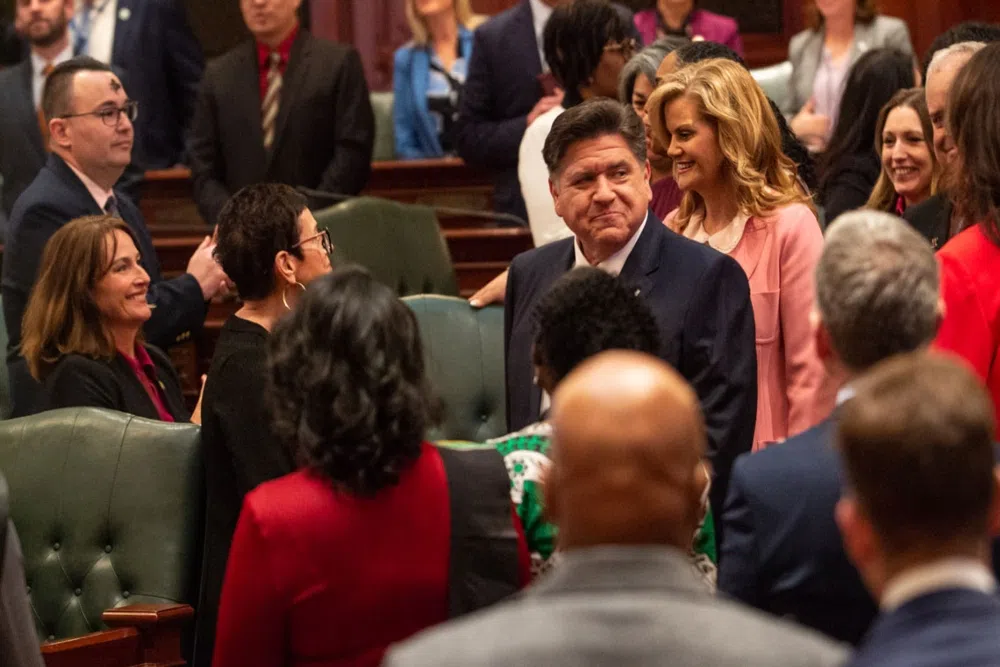
The governor delivered the final budget address of his second term on Wednesday, proposing a spending plan that largely maintains the status quo and forgoes significant broad-based tax increases.
Pritzker also accused the Trump administration of costing Illinois billions of dollars in lost revenue via cuts or policy changes.

“I have joked with many of you that I wish I could spend just one year of my governorship presiding over precedented times,” he told the joint session of the General Assembly.
He said the proposed $56 billion fiscal year 2027 budget required him to make hard choices, but he argued it is ultimately the best path for the state to navigate its way through uncertainty driven by Washington.
“It levels off and in some cases reduces programs that are important to me — some of which were proposals of my own,” Pritzker said. “But I believe that the imperative of responsible governance and overcoming the fiscal irresponsibility of past decades must come ahead of the interest of any one politician, program or party.”
The proposal represents an increase of $878 million, or 1.6%, from the current year. But most of that news spending is in required categories like education and pensions. Outside those areas, new spending will grow by just 0.5%.
Open interactive chart in a new tab
On the revenue side, the governor is expecting $56.1 billion in FY27, which would be an increase of $830 million from current-year projections.
Like the last two budgets, Pritzker is again opting for targeted tax increases that will be paid by businesses rather than consumers. His proposal does not include new taxes on millionaires and billionaires and corporations sought by progressive Democrats. Instead it would tax social media companies, raising a projected $200 million in revenue.
Tax on social media companies
Pritzker’s plan calls for raising $589 million in new revenue.
The hallmark of the plan is a new tax on social media companies with at least 100,000 users in Illinois. The companies would be taxed on a graduated scale beginning at 10 cents per user each month. Platforms with a million or more users would be taxed $165,000 each month, plus 50 cents each month on the number of users over a million.
Open interactive table in a new tab
Pritzker is hoping to raise $200 million from the new tax — a more limited amount than a digital advertising tax floated last year that would have racked in hundreds of millions of dollars each year.
“Social media algorithms have been proven to create mental health issues in adolescents and foster polarization and misinformation in society as a whole,” Pritzker said. “Those companies are profiting from online engagement of Illinois consumers, and they currently contribute nothing to ameliorate the negative effects of their platforms.”
Pritzker’s plan would also raise new funds by adjusting a cap on operating losses reported by businesses and aligning taxes on table and electronic games with each other.
Budget officials in the governor’s office also said they aren’t assuming the worst-case economic scenario in FY27. They said the budget is based on S&P Global’s January outlook, which shows a stable forecast that assumes personal consumption will continue to grow, corporate profits will remain flat and the economy won’t be plunged into a recession.

For the current fiscal year, the governor’s office expects revenue to be about $70 million lower than was first projected when Pritzker signed the budget last June.
Federal uncertainty
Pritzker’s administration is also assuming it will win court battles to continue receiving federal funding that President Donald Trump’s administration has attempted to cut. About $1 billion in child care funding is currently in limbo as the state sues to continue receiving funding, according to the governor’s office.
Pritzker said when Trump took office, he was hopeful the election-year threats to gut programs were “the kind of unrealistic hyperbole that fuels a presidential campaign but then is abandoned when cooler heads prevail.”
Instead, the president stuck to those pledges — and Pritzker pegged the fallout at $8.4 billion for the state.
“These are not handouts,” he said. “These are dollars that real Illinoisans paid in federal taxes and that have been constitutionally approved by our elected Democratic and Republican representatives in Washington.”
The governor, who many speculate will run for president in 2028, admonished the Trump administration for denying disaster relief funding to Illinois and instead requiring the state to paint over any rainbow crosswalks in Chicago.
“I want to say to anyone on either side of the aisle: If you want to talk about our FY 2027 budget, you must first demand the return of the money and resources this president has taken from the people of Illinois,” Pritzker said.
But the governor’s budget office also projects the state will face multibillion dollar deficits in the coming years as more cuts and new requirements for social services passed by Congress take effect. Pritzker told reporters on Wednesday following the speech that new spending on hiring and software included in his budget proposal is “building that infrastructure in order to deal with future years and making sure that we don’t get hit even harder.”
Little new education spending
While overall spending in the budget would grow by hundreds of millions of dollars, lawmakers and advocates who wanted Pritzker to propose spending big chunks of money on new services this year did not have their wishes granted.
Open interactive chart in a new tab
But the governor’s office said the proposal also does not include major cuts to programs.
Funding for K-12 public schools via the state’s Evidence-Based Funding formula would increase by $305 million and, for the second year in a row, exclude roughly $50 million that would be designated for property tax relief.
Advocates, including teachers unions, have implored state lawmakers to significantly boost EBF funding, arguing the formula is not doing enough to direct necessary dollars to the state’s neediest school districts. Budget officials in the governor’s office said they believe the state is still maintaining progress toward improving funding for those schools.

“I 100% agree that we need a bill that equitably distributes money to the schools and that we need more to go to our universities,” Pritzker told reporters. “The principles are all there. I think there are some tweaks and some questions that we need to get answered before we can get into a final result.”
Other new spending for education this year includes $35 million to the Illinois Department of Transportation that would go toward helping mass transit districts provide transportation for students to and from school.
Fiscal year 2027 will also be the first year the new Department of Early Childhood begins full operations. Funds previously allocated through the State Board of Education, Department of Human Services and Department of Children and Family Services will be consolidated under one roof, totaling $2.1 billion in General Fund spending for the new agency.
The state’s universities and community colleges will also see just 1% growth in spending for the second year in a row under the plan. The Monetary Award Program, more commonly known as MAP, will have funding remain flat at $721.6 million.
Other spending areas
A program that provides health care to immigrant seniors regardless of whether they’re living in the U.S. with legal permission is also remaining in the budget, despite pushback from Republican lawmakers.
The program was significantly scaled back in the FY26 budget and limited only to qualifying seniors and is projected to cost $143.6 million in FY27. Last year’s budget cut a similar program for immigrant adults.
Open interactive chart in new tab
Funding for Home Illinois, the state’s homelessness prevention program, is proposed to remain flat at $253.7 million after being reduced by about $15 million in the current year.
The Department of Children and Family Services would see an increase of $74 million, or 4.7%, in Pritzker’s proposal. It would boost support for caregivers and intervention services.
Pritzker also proposed allocating $2 million to fund two new classes to train 100 new state troopers. The Department of Corrections would also get $103 million in new funding to add new administrative positions and 100 correctional officers.
The state is also expected to spend $100 million beginning in the current fiscal year on new staffing and technology costs to implement new requirements from the president’s domestic policy bill that was signed last summer.
Pensions would also be fully funded with $10.7 billion as Pritzker continues to pitch the General Assembly on supporting a pension reform plan.
Local governments might get a smaller cut of revenue, however. The governor proposed lowering the percentage of income taxes that goes to local governments to 6.23%. That would keep $60 million in state coffers, budget documents show.
The “rainy day” fund, on the other hand, would increase by $176 million, bringing it to roughly $2.5 billion.
Policy priorities
A year after delivering a politically heavy speech that focused on Trump’s return to power, Pritzker focused much of this year’s speech on his legislative agenda for the spring.
Pritzker’s nonbudgetary proposal included:
- A ban on “junk fees,” or the advertisement of a price that doesn’t disclose all fees.
- Statewide zoning laws and capital funding to spur housing development.
- A renewal of a community college bachelor’s degree proposal that stalled last year.
- A ban on cell phones in schools, also revived from a year ago.
- An executive order aimed at spurring new nuclear power development.
- The “Children’s Social Media Safety Act” to increase parental controls, regulate how content is packaged to children and require social media companies to increase privacy settings on children’s accounts.
- A moratorium on tax credits for data centers.
(Reporting by Ben Szalinski, Capitol News Illinois. Jerry Nowicki contributed.)
Capitol News Illinois is a nonprofit, nonpartisan news service that distributes state government coverage to hundreds of news outlets statewide. It is funded primarily by the Illinois Press Foundation and the Robert R. McCormick Foundation.
This article first appeared on Capitol News Illinois and is republished here under a Creative Commons Attribution-NoDerivatives 4.0 International License.




Comments